Sunday, March 15, 2020

British Library/British Museum UPDATED


 I've always wanted to visit the British Library and had never had a chance previously.  This is my third visit to London, so I guess the third time really is the charm!
This is quite a powerful combination for me - books and a reader's card!  Let me at 'em!  (Oh wait -  they did - WAHOO!!)
I love the inscription at the top of the card.  I am here to do research, but I know I will find inspiration and enjoyment.  In fact, that has already begun!  The library itself is just jaw-droppingly beautiful, and, among other things, it has a very large exhibition room where anyone can wander in and see treasures from many fields: music, science, literature, geography, etc.  I'll give a visual tour first, of the library and some of the exhibitions, and then zoom in on what it was the drew me here very specifically.
The Terrace Restaurant

The following photographs are but the smallest sample of what is contained in the exhibition rooms.
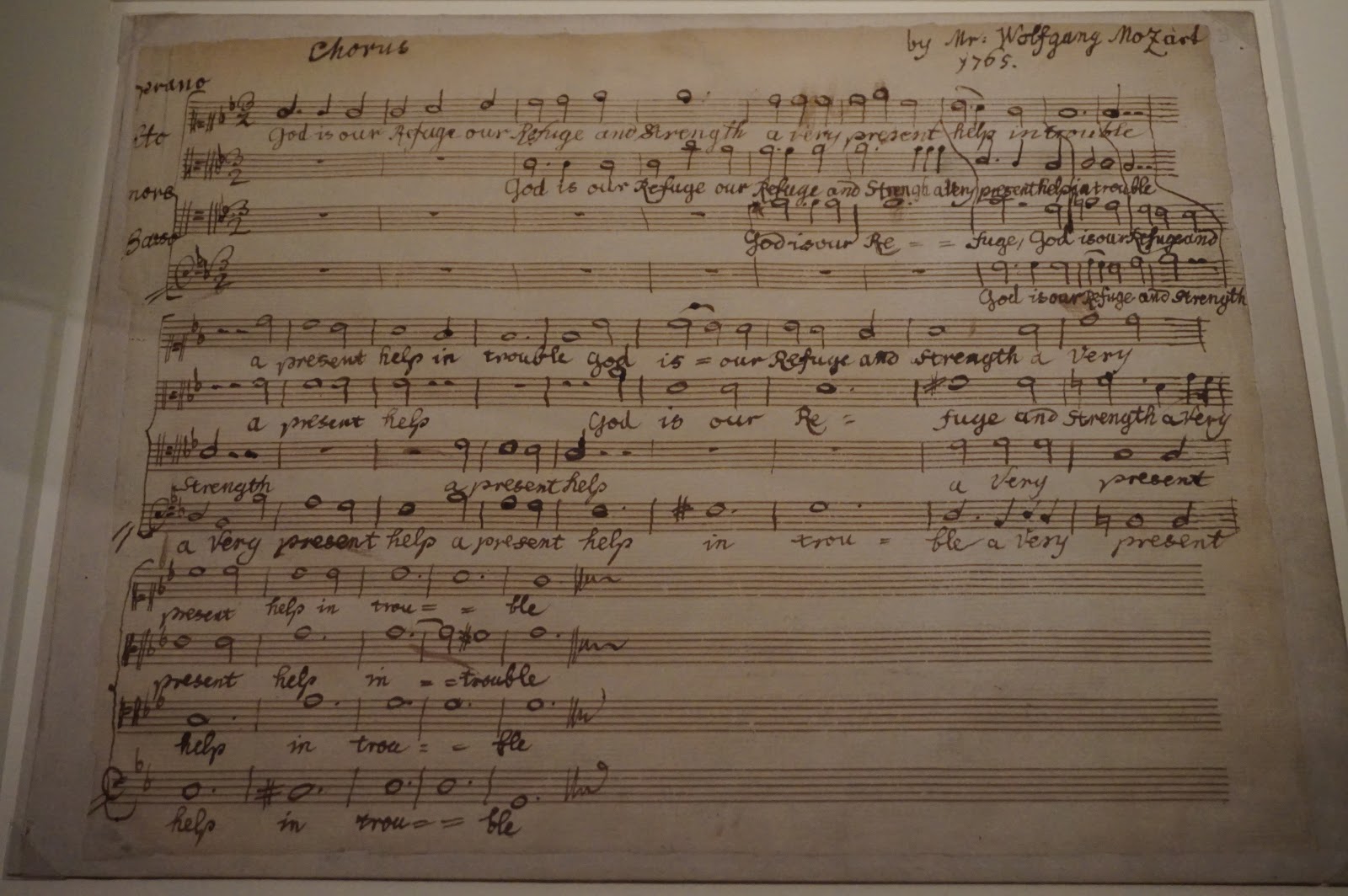
God is Our Refuge (Mozart, age 9)

Earliest known printed world map to show America (an extension of Asia)

Jane Austen's writing desk with a letter to her brother Frank on top

Some of the Angria juvenilia by Charlotte Bronte

The Gondal Poems by Emily Bronte
 Those of you who know me well are probably surprised I was capable of taking pictures of the above Bronte works rather than fainting dead away from excitement!  Are you kidding me?!  Emily Bronte's poetry in her own hand!  (I can't help but think how upset Emily was when her sister Charlotte got into her things and discovered these poems.  Emily was so private, yet here this is on display for all the world to see  .  .  .  of course they had ended up publishing after that episode, so  .  .  .)
 And above we have the philatelic collections, and below we have books, books, BOOKS!!!
OK, so certainly all of the above was way more than enough to draw me here!  But I am actually traveling on sabbatical to study The Sorcerer Mathematicians of the Renaissance, and I was here for Dee, John Dee.
I wish I could show pictures here of this scroll unrolled.  I may be able to in a later post; I just need to write the permissions department at the library and get an OK first.  I want to share it, because it's so amazing that I thought I could not possibly get permission to view it - let alone touch it or photograph it.  I learned of the existence of this scroll while doing research at home prior to my travels.  It contains the genealogies of John Dee and Queen Elizabeth I (hence their relationship to each other, which Dee was trying to promote as he sought position at court), and these lines of descent go all the way back to King Arthur and his father King Uther Pendragon!  The scroll is filled with beautiful calligraphy, paintings of heraldic shields, and a self-portrait by Dee (thought to be the only extant contemporary likeness of Dee).  I touched and handled this scroll, hand-drawn in the 16th century by John Dee.  I know I'm repeating myself, but I can't stress strongly enough how surprised I was to be able to access this scroll.  Dee has become a very popular cult/occult figure, and this scroll is well over 400 years old.  It just goes to show you what kinds of doors can open to a math professor on sabbatical, and I am humbled and privileged in this!

*****

After that I almost can't write about anything else, but later that evening I also went to the British Museum.  Here too the focus was Dee.  I had already seen Dee's items on display at the Royal College of Physicians four years ago, but I wanted to see them in their usual home - different display, might hit me differently, who knows.  I'm going to wait to share pictures of that display, but I will share other images of and from the British Museum. 
King Nebuchadnezzar II's Babylon
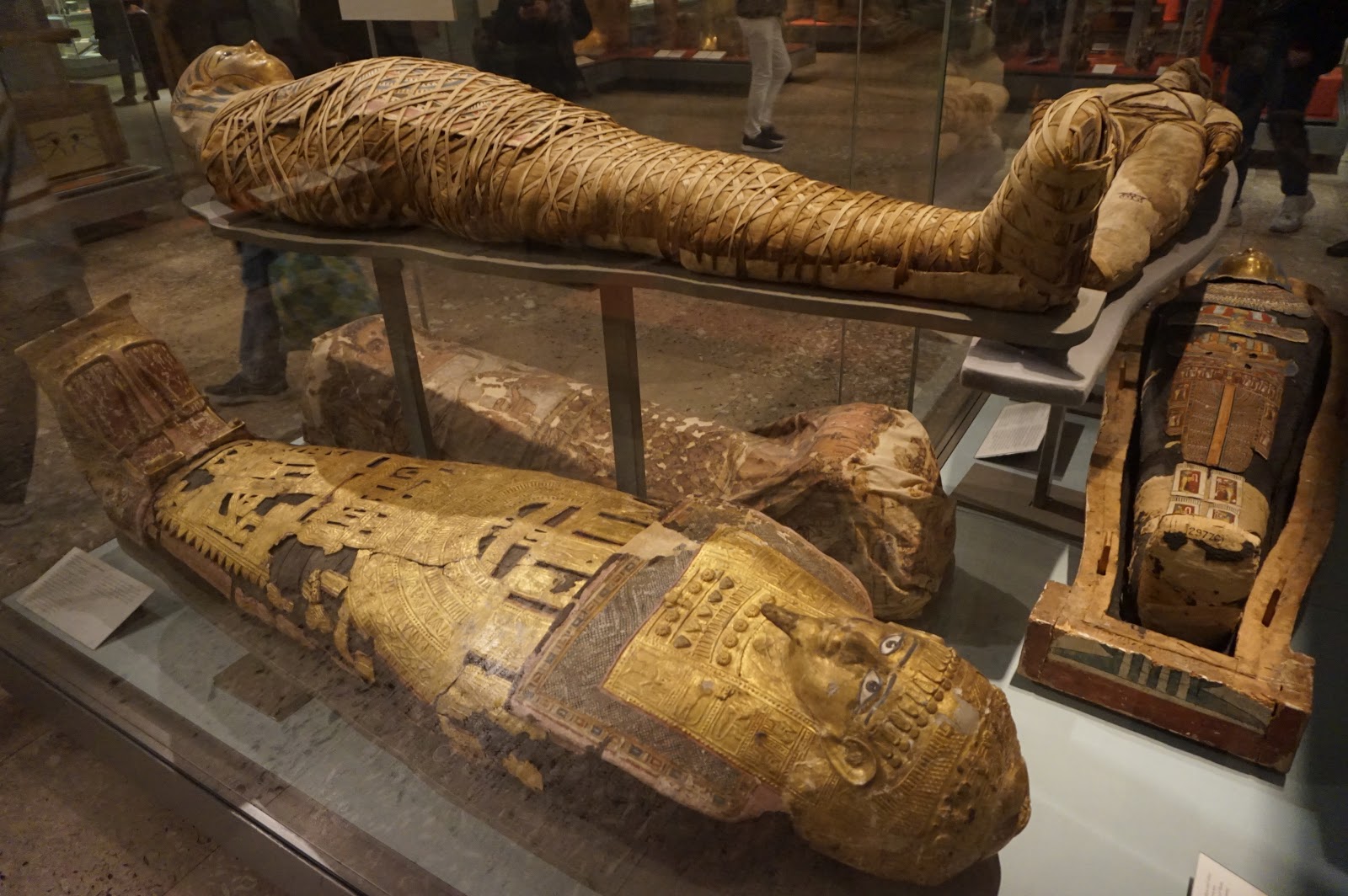
Mummies

I don't usually spend too much time in the Egyptian section.  It's amazing and everything, but the history goes back so many thousands of years that my brain can't process it, and I end up feeling like I've fallen into a black hole!
I do always gravitate to two items: The Rosetta Stone and the Elgin Marbles.  In the first picture below I'm actually wearing a shirt that I just bought that has the Rosetta Stone on it, but the lighting is such that you'll just have to take my word for it.  (I don't normally buy souvenirs, but for this I made an exception!  It'll be a good shirt to wear in my classroom when I'm teaching multiplication with Egyptian numerals!)
 OK, I know some of you do read Greek.  How ya doin' with the lower script in the image below?
 Elgin Marbles:
Why did I not realize that the actual original of the Royal Game of Ur would be on display?  This was another moment of nearly fainting.
The Babylonian tablet below contains directions for the game - the earliest known set of directions for a board game - and it was museum curator Dr. Irving Finkel who painstakingly translated the directions and therefore revived this once universal game!
In the following video that I took from YouTube Dr. Finkel talks a little bit about this discovery and translation.  He is a hero of mine, and I was keeping my eyes open hoping to see him at the British Museum!  (But then I would really have fainted - though only after getting a selfie with him!)


And may I just say, DR. FINKEL, SIR, YOU ROCK!!!!

OK, I don't know where to go from there, so I'll stop.  That was an awful lot of excitement in one day!  I'm posting this on my fourth day, and I have no idea how I'm going to keep up with this!  There is just too much awesome stuff!


Thursday, March 12, 2020

Travel and Arrival

 It seemed surreal yesterday that, after 2 years of planning, the day to fly had finally come!  Fortunately for me, I got to go to my final destination; others on my flight got turned around.  When we took off from San Francisco, "pandemic" had not yet been officially declared; when we landed in Boston it had, and airline employees were scrambling to deal with the ramifications of this for passengers who were heading through the UK (London) to another European destination.  That could have been me.  The final destination today was supposed to have been Rome, but I made the hard choice a couple of weeks ago to cancel my Italian study destinations and move all my research and travel to the UK.  But who knows what even that will look like a week or two or a month or two from now!  I just have to reiterate how bizarre it was to be in the air, literally, as these changes were implemented - got on the airplane in one place under certain rules - got off that same airplane 5 hours later under different rules!
I feel very bad for the other travelers.  Astonishingly, my experience was that it was one of the easiest long-distance travel situations I've ever been in.  The decision to go forward with it wasn't easy, but doing it was.  God's hands were just all over this, and I feel blessed.  One of the things that throws me is that I can tend to get anxious about details, especially when traveling alone, but everything went so smoothly.  For example, getting an Oyster Card from the machine at the airport was probably one of the easiest things I've ever done in my life!  (Some of you are probably thinking to yourselves, "Duh!" and others are thinking, "What's an Oyster Card?!")
This was a milestone moment - plane travel was over - last leg of the journey was here - HOPPING ON THE TUBE!  What a joy to see it!  (Piccadilly to District and off at Bayswater - no problem!)
 And what a joy to see my hotel! It's very pretty  .  .  .  on the outside  .  .  .
I think this room is tied for the smallest hotel room I've ever stayed in.  I took this picture from just inside the door to the room.  You can barely open the wardrobe doors without banging the wall, and see that rectangular thing in the front middle of the picture?  That's my chair(?!).  That's where I'll be sitting to do my reading and research and blogging and communicating.  And this room is actually BIGGER than the one I originally booked because I got an email a couple of days ago asking if I wanted to upgrade to a bigger room for a reasonable charge.  Here it is - the BIGGER room!  (Online pictures in hotel advertising can really be deceptive!)
I'm also reasonably certain that the paper coasters left in the room came pre-used, which makes me wonder about the cleanliness of the room in general (ooph!).
I mean  .  .  .  it's actually pretty cute  .  .  .  from certain angles  .  .  .  But the room is basically this bed, and that's it.  I'm really, REALLY hoping that neither I nor anyone else in this hotel gets COVID-19, because if I have to be quarantined in this little teeny-tiny room with not even a chair for 2 or 3 weeks I think I will lose my mind!  

I decided to get out immediately and get walking while I can - just in case!
I love it that the British do this on their roads!  My travels were easy, but I still basically had two back-to-back days with no night, and I was TIRED.  Given that they drive on the opposite side of the road than I'm used to, it's really nice that they've provided reminders for which way to look for the traffic to be coming from.  (I might have died today otherwise!)  Well, not right here since there's a barricade, but  .  .  .  you know  .  .  .
 So  .  .  .  I should have been in Italy today  .  .  .  today Rome, then many other cities, including Venice.  I feel like I saw a little bit of a faux Venice in London today with the canal and boats and also the pigeons, which I hear fill St. Mark's Square.
There was more of a purpose to my walk than just getting out.  When I was here 4 years ago for a week, I tried really hard to get out to Kensal Green Cemetery, because there is a famous mathematician buried here, and I wanted to include this person in my previous travel report.  But Kensal Green is rather away from the other sights I needed to visit, and I was always WAY too tired at the end of the day to try to tack it on (which is saying something!)  So this time, it was my first excursion.
 I had learned from previous, unsuccessful ventures into graveyards to try to find a specific grave that it's harder than finding a needle in a haystack.  So this time I got smart and did my research.

And then I left my research in the hotel room and had to go from memory.  Check out the map above, that I came across when entering the cemetery, how many areas and lanes there are!  When I found the grave I was looking for I raised my hands in the air in triumph and gave a little "Whoo!"

But, both the mathematician and the cemetery are going to have posts of their own, so here's a lovely picture of some stones for now:
As I walked I noted that the US is not the only country that has had a run on sanitizers and antibacterial wipes.  (Thank you Jacqueline!)
After all the travel and the walking (45 minutes each way with way too long spent standing and walking in the cemetery), I decided just to take one other quick jaunt before heading to dinner and "home."  I decided to just cut across the corner of Hyde Park that separates me from my neighbors William and Catherine.
The rainbow over Round Pond felt symbolic and gave me joy to see!  And I imagine Wills and Kate and their three children must have enjoyed it as well, as viewed through their windows.
So, here we are at Will and Kate's place: Kensington Palace.  Just a guess here, but I'm thinking their rooms are a tad bit more spacious than mine  .  .  .  just guessing  .  .  .  just guessing  .  .  .

Since I was supposed to be in Italy today, what else would I eat but Italian food - my standard choice: the most plain pasta dish I can find with a lemon-lime soda.  Ah  .  .  .
 And right in front of my face was a poster of Rome!
I've never been to Italy, I'm sad to be missing it on this trip, but I am more than happy to be in jolly old England!

Thursday, March 5, 2020

Pre-travel Alchemy Explorations


As mentioned in my introductory post, a goal I have in my research is to study the work (and lives and ideas) of these mathematicians on their terms.  Keep in mind as you read, though, that I am a math professor digging into history that I'm passionate about and that I am not a history professor trained in methods of historical research.  So I will study my Renaissance mathematics on their terms as best I can.  In my previous sabbatical most of the mathematicians I researched lived in the 19th century; in this sabbatical I'm focused on the 16th century, and that makes QUITE a difference!

To put this in perspective, my great-grandfather, whom I knew and interacted with, was born in 1877.  Also, my "first best friend," our next door neighbor when I was a little kid, was born in 1890.  She was part of my life for 20 years.  So it feels to me like the 19th century is within my reach, so to speak.  This is not even close to being the case with the 16th century - a time before the industrial revolution and before the Age of Enlightenment - a time when there was no distinction between alchemy and chemistry nor between astrology and astronomy.  The New World had been "discovered" by Europeans only 9 years prior to the birth of Girolamo Cardano.  This was an era of cataclysmic change -- an era of Renaissance and of Reformation. Europeans had only known One World and One Church for over a thousand years prior to this, and suddenly there were two worlds and multiple churches.  Trying to truly get my head into a 16th-century mindset feels like traveling to an utterly different universe.
Egyptian Rosicrucian Museum (front entrance), San Jose, California
As a professor of mathematics I teach math -- seems obvious, right?  But in the 16th century a mathematics professor would have primarily taught astronomy and astrology; the math would have been seen mainly as preparation for those other, more important topics.  Among other things, astrology was considered an important part of the practice of medicine.  Part of diagnosing a patient involved determining the impact of the heavens on their health and life.  Many scholars of the time were also alchemists, as was Sir Isaac Newton a full century later!  Yet today we consider astrology and alchemy to be pseudoscience at best, and perhaps even demonic at worst.  And yet I know Cardano, Dee and Napier to have been not only intellectual giants but also devout Christians.  If I am to try to understand these scholars and their work on their terms -- at least to the degree that I can, I need to work on wrapping my mind around alchemy and astrology as used and seen in their world, in their time.  And so, as a start, I set off for the nearby Egyptian Rosicrucian Museum in San Jose, California in order to see their newly installed alchemical exhibition.
Reproduction of an Alchemists Workshop
Mathematician John Dee studied the works of the English Augustinian canon and alchemist George Ripley (1415-1490).  This Rosicrucian museum has a replica of a Ripley Scroll, an alchemical document with references to the philosopher's stone.  None of the 23 original such scrolls in existence were created by Ripley himself, but many do contain poetry associated with him and are therefore named for him.

Reproduction of a Ripley Scroll, Egyptian Rosicrucian Museum (2020)
I was privileged last summer to have seen one of the 23 originals still in existence.  It was being displayed publicly for the first time and was at Edinburgh's Royal College of Physicians.
A Ripley Scroll, Royal College of Physicians, Edinburgh (2019)
I made this trip to San Jose about a month ago and had at that time written a lot of words in what remains of this post.  Since that trip I have done a great deal of reading, and I have found even more deeply the truth of the maxim "The more you know, the more you realize you don't know!"
A sample of the eclectic collection of books I've been reading on the alchemy and astrology of my mathematicians.

As Alexander Pope so wisely writes:

A little learning is a dangerous thing;
Drink deep or taste not the Pierian spring:
There shallow draughts intoxicate the brain,
And drinking largely sobers us again.

So I have cut most of the rest of my words - will leave this mainly to pictures - and will leave it simply as evidence of my first foray into this area of study.
Alchemical Mandala: Azoth of the Philosophers
Prayer Chamber and Work Area of an Alchemical Laboratory
Replica of the Emerald Tablet of Hermes Trismigestus
So, given that my studies involve the Renaissance Era, why was I at a museum focused on ancient Egypt?  Well, the word alchemy itself comes from the Arabic word "al-khemiyah," which literally means, "the black soil of Egypt."  The Emerald Tablet (replica pictured above), written using the Phoenecian alphabet, is the core text of alchemy and is said to have been written by the Egyptian priest Hermes Trismigestus ("Thrice Greatest Hermes"), who is associated with the Thoth, the Egyptian god of science.  Alchemy goes back at least as far as Greco-Roman Egypt, and it spread throughout Europe, Africa and Asia.  It differed by varying degrees in different times and different places, but the Renaissance was a time of looking back to ancient sources, and so its Hermetic and Platonic foundations (which also became mixed with Christianity -- Hermes' writings being seen as priscia theologia) were honored above changes in alchemical practice and thought that had come about in medieval times.

I'll close here with other images from the Egyptian Rosicrucian Museum and am looking forward to the European part of my explorations.


Note the x-ray of the Mummy below the Mummy


Post Scipt: I should be leaving in 6 days for my Europe travels and studies, but things are still up in the air as the new coronavirus COVID-19 situation continues to develop.  It's very weird to be gearing up as much as I am and to be so close to my departure date and to not be sure if it's going to happen or not. 

Tuesday, February 25, 2020

Travel

A major tarmac delay in from a previous trip
POST SCRIPT: I had drafted this post to go up on March 11, the day I was to fly out to Rome.  Most of my time in Italy is (was?) to have been spent in northern Italy, but as I watch the coronavirus warnings on the news it looks like if I were to head to the areas of Venice, Padua, Pavia, and especially Milan, that I may not be allowed out and into the UK to continue my travels.  That's just a prediction, but I fly out in 2 weeks and will spend (would have spent?) 5 weeks in Italy.  Who knows what that virus is going to do over that period of time. So at this point everything is up in the air (no pun intended), and I'm scrambling to change over the course of a few days the plan that had been carefully crafted over the course of a year and a half (two years, really).  Originally my concerns about travel were the discomfort of long flights and the details of setting up phone service in Europe-- am getting a little change of perspective on that.


*****


This trip that I am beginning is an AMAZING opportunity!  However,  to say I'm looking forward to countless hours sitting on a plane would be a lie.   And to say I'm not nervous about this trip would also be a lie. I am a shy, introverted person who appreciates above all else the comforts of home; I also tend a bit towards anxiety.  (And some of you reading this are chuckling right now because you know that to say I tend a "bit" towards anxiety is like saying the ocean is a "bit" wet!)  BUT, I am so passionate about the history of mathematics and about the particular mathematicians that I am studying that there is no way I would not have jumped at the chance to do what I am doing!
As I've been reading about my mathematicians, something that has caught my eye has been their travel experiences.  I mentioned in my introductory post that Cardano and Dee had met in London (1552).  That meeting actually happened as Cardano was on his way back home to Pavia from Scotland - an even further destination.  As the second most renowned physician of his day (behind Vesalius), Cardano was asked by Archbishop of St. Andrews, John Hamilton, to come and treat him.  Cardano left Italy on February 23, 1552 and arrived in Scotland on June 29, 1552 - a journey of just over 4 months!  He did have a bit of a "layover" in Paris  .  .  . but still, in comparison to the somewhat less than 24 hours it will take me to cover the 6250 miles from home to Rome, the FOUR MONTHS it took Cardano to cover the 1500 miles from home to Edinburgh is quite the journey and kind of puts mine in perspective.

On the other hand, I won't have servants along attending me  .  .  .  hmm  .  .  .

John Napier left his Edinburgh home in 1563 to travel to the European Continent in order to continue his education. He was just 13 years old at the time!  He would have had a servant with him, but no amount of help could come near to alleviating the rigors of travel.  Depending on weather (and pirates!) it could take up to 10 days to go by ship the short distance from Scotland to the Netherlands.  Traveling by land was actually harder.  Among other things it was best to present one's-self as being impoverished so as to avoid the notice of the robbers who roamed the roads.  Even at an inn it wasn't a good idea to pay for a bed or a good meal because that would show you had money, so sleep might have to be on a bench or table or in a stable.  As uncomfortable as this sounds, it might not have been so bad in comparison to a bed, however, as a bed might have to be shared by multiple travelers (strangers) and could be filthy and flea-infested.

It isn't known where Napier studied on the Continent.  It may have been as nearby as the Low Countries, or further on to Paris or Geneva (most likely), or perhaps even as far away as Italy.  But one thing is certain, his travels would have been neither brief nor comfortable!
And then there's John Dee who left his most dearly beloved home in Mortlake, England to travel to central Poland.  He set out on September 21, 1583.  Once he had made his way along the Thames and out into the North Sea, a storm drove his ship back towards shore where they would have to wait a week for a new anchor to arrive. Getting back from ship to dinghy to shore was an ordeal that left Dee falling into the sea and becoming "foul arrayed in the water and ooze."  Once across the sea, they made their way across the Netherlands towards Denmark, a trip not made easier since Dee had packed at least 800 of his very favorite books!  Onward they went through Germany and then, with "slow, perilous progress," over into Poland.  Between two of the cities in their travels they had to hire two-dozen men to clear a two-mile stretch of road to enable their coaches to pass, after which they found themselves marooned outside the city, which was surrounded by floods.  On February 3, 1584, he finally arrived in Lask.  This journey, as had Cardano's, took just over four months.
So, no matter what the next 24 hours have in store, I'll be spanning the distance of about a fourth of our globe in that relatively short time - and mostly sitting in a chair!  One car, three planes, and a train later, I will arrive at my hotel, which is located directly behind the Pantheon in Rome - and that will be a glorious sight to behold!!  POST POST SCRIPT - Well, that was the original plan - not at all sure what the alternative plan will turn out to be - a much more "interesting" journey than anticipated!!  I sure hope it doesn't get as "interesting" as any of the three examples above!